February 05, 2026
Portchain’s Sailing Predictor: Real-Time AIS for Berth Scheduling
AIS-based sailing prediction for stable port call planning
Portchain’s Sailing Predictor focuses on one core question berth planners face every day: Is this plan feasible? In container shipping, even slight changes in speed or timing can quickly cascade across multiple port calls, resulting in manual coordination, late replanning, and reduced schedule stability. Better predictability supports earlier decisions and more stable operations across vessel rotations.
Portchain’s Sailing Predictor is built to address this challenge. It is purpose-built for container shipping and designed to support operational planning decisions across schedules and port calls. The predictor uses AIS data to generate continuously updated forecasts of how container vessels are expected to sail, allowing planners to assess feasibility and risk earlier in the planning process.
More than one million AIS data points are processed per day by Portchain’s Sailing Predictor, allowing planners to work with predictions that refresh continuously as new vessel movements become visible, rather than relying on static ETAs (Estimated Time of Arrival). Alerts and notifications surface changes as they become visible in the data, rather than after deviations have already propagated through the schedule.
Portchain’s Sailing Predictor is powered by AIS data, supported by satellite AIS for global coverage. This ensures visibility of the global container fleet, including in remote and low-traffic waters. Route patterns and speed profiles are learned from AIS observations over time and updated continuously as new signals are received, reflecting how container vessels actually sail in practice.
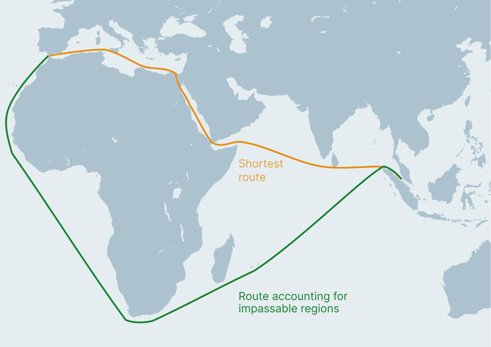
Graphic 1. Impassable regions
Predicted route accounting for regions vessels are unlikely or unable to pass.
In daily operations, sailing predictions are used to spot issues early and reduce last-minute replanning. A central signal is Risk of Delay, which checks whether a planned arrival is physically achievable. The predictor compares the speed required to meet the scheduled arrival time with the vessel’s maximum speed and flags risk when the plan is unlikely to hold. Today, the clearest warning is shown for the current or last sea-leg, with additional legs available for context.
A recent example illustrates the value. An agreed ETA for a vessel call was flagged as not physically feasible. The vessel’s maximum speed was 20 knots, while meeting the ETA would have required sailing at 27 knots. With that early signal, the berth planner adjusted the plan immediately and notified the vessel operator through Portchain, rather than waiting for the vessel operator to engage later. This allowed replanning to happen early, before the situation became urgent.
Speed Alerts and Multi-Port Optimization Alerts support carrier planners in managing schedule stability across rotations. Speed Alerts flag when a vessel is sailing faster than necessary to meet its confirmed arrival time, enabling Just-In-Time port calls and reducing early arrivals and unnecessary idle time. Multi-Port Optimization Alerts detect downstream delays and congestion across multiple terminals and identify opportunities for multi-port optimization. This allows planners to anticipate knock-on effects earlier in the planning process and take proactive measures to reduce bunker cost and ensure schedule reliability.
In one case, a vessel was sailing at 19.2 knots with an estimated arrival well ahead of the terminal’s confirmed ETA. After a slowdown alert was issued, the vessel reduced its speed to approximately 12.7 knots, saving an estimated 158 tonnes of fuel while arriving Just-in-Time. Historical arrival data indicated that the terminal’s ETA was unlikely to advance significantly, providing planners with confidence to act early and maintain the plan's stability.
 |
 |
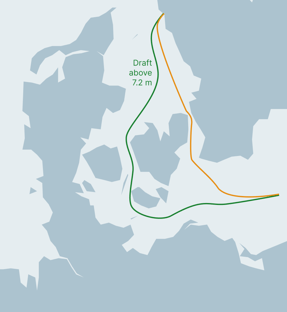
| Graphic 2. Draft constraint Predicted route adjusted based on vessel draft. |
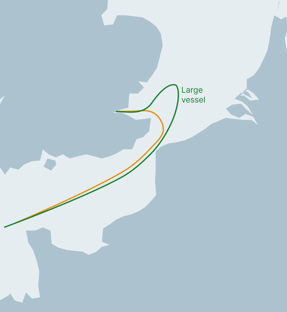
Graphic 3. Vessel size Predicted route reflecting differences in how vessels of similar size typically sail. |
Alongside timing and speed predictions, route predictions also account for vessel-specific constraints such as draft, vessel size, and regions that are impractical or impassable. Rather than assuming shortest paths, predicted routes reflect how vessels are expected to sail in practice, supporting more reliable ETA and speed predictions across global networks.
Portchain’s approach is grounded in AIS observations at scale and delivered as planning signals on top of traditional vessel position tracking views. Satellite AIS supports continuity beyond dense coastal coverage, while high-frequency processing enables frequent updates across fleets. The output is designed to support planning workflows, enabling teams to intervene earlier and maintain stable berth schedules.
Learn how berth planners use Sailing Predictor to act earlier and avoid last-minute replanning at www.portchain.com
Author: Portchain Analytics Team
Press of this article
More from Portchain

Portchain appoints Rasmus H. Sørensen as Vice President of Product
Portchain appoints Rasmus as Vice President of Product. Portchain appoints Rasmus for the newly-created role of Vice President of Product

South Carolina Ports and Portchain collaborate to digitalize berth planning
South Carolina Ports rolls out Portchain to digitalize berth
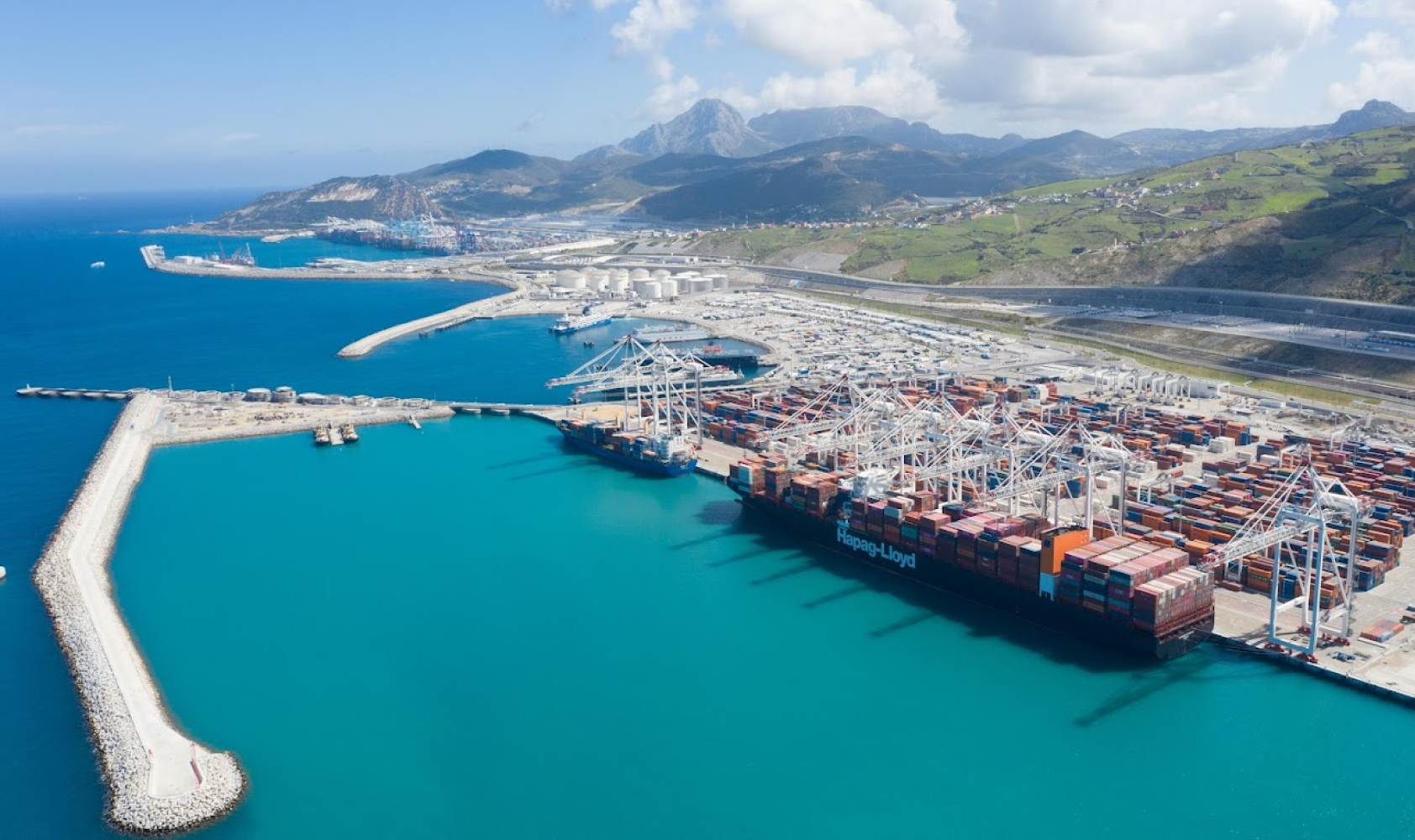
Portchain Berth Optimization Engine deployed by Tanger Alliance
Portchain's Berth Optimization Engine (BOE) deployed within Container Terminal 3 – Tanger med II operated by Tanger Alliance
Subscribe
to our Newsletter